CASE STUDY REWRITE
The work was good but understanding it took too much work.
Amandeep had a detailed research project in his portfolio. The challenge was figuring out what someone needed to know to appreciate it.
His case study covered a mixed-methods study of eBay’s Search Results Page. There was a lot to work with: 4,141 survey responses, 20 interviews, different stakeholder priorities, recommendations, and measurable product outcomes.
But having all that information also made it difficult to decide what to focus on. What needed more explanation? What could be cut? And what would someone outside the project actually take away from it?
That’s where I came in.
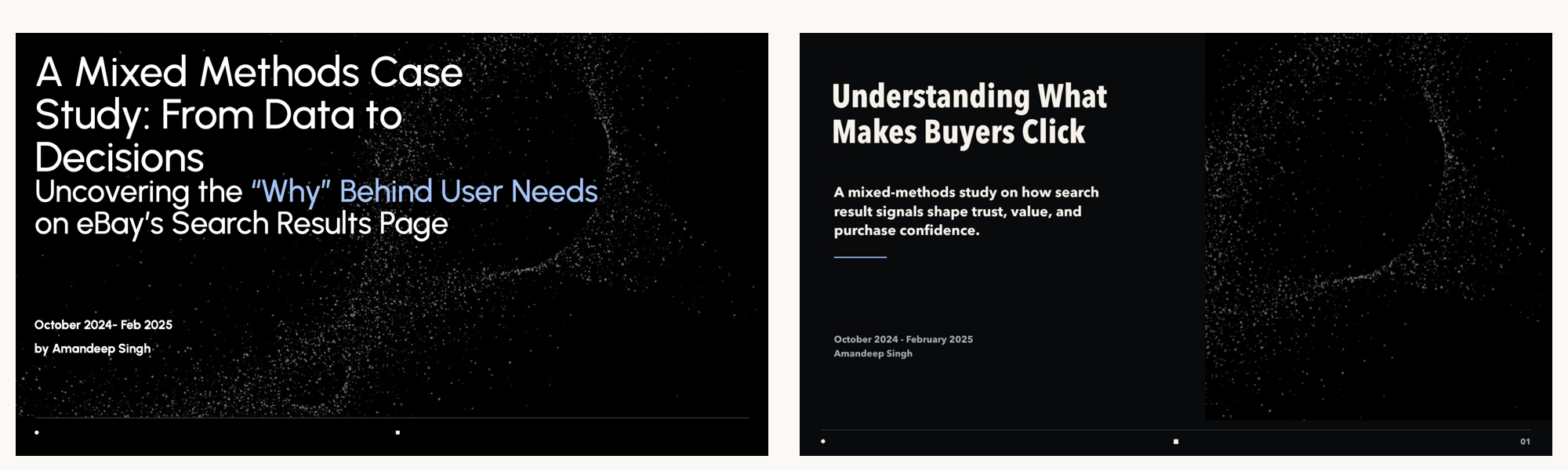
37 slides → 24 slides
We ended up with fewer slides because the story became more focused. There wasn’t a slide count we were trying to hit.
It read like a report, and Amandeep could feel it too.
“It definitely felt a bit more like a report.”
That was how Amandeep described the original. He knew the project well, but condensing it was difficult. As he put it, “I didn’t know what were the parts to highlight.”
I think that’s an easy place to get stuck with your own portfolio. You know why something mattered because you were there. The person reading it doesn’t have that context, and they may not stick around long enough to figure it out.
For Amandeep, that also meant figuring out the order. What did the reader need to understand first? Which section should come next? Where were we expecting them to make a connection we hadn’t explained?
He later said this was something he hadn’t been able to diagnose himself.
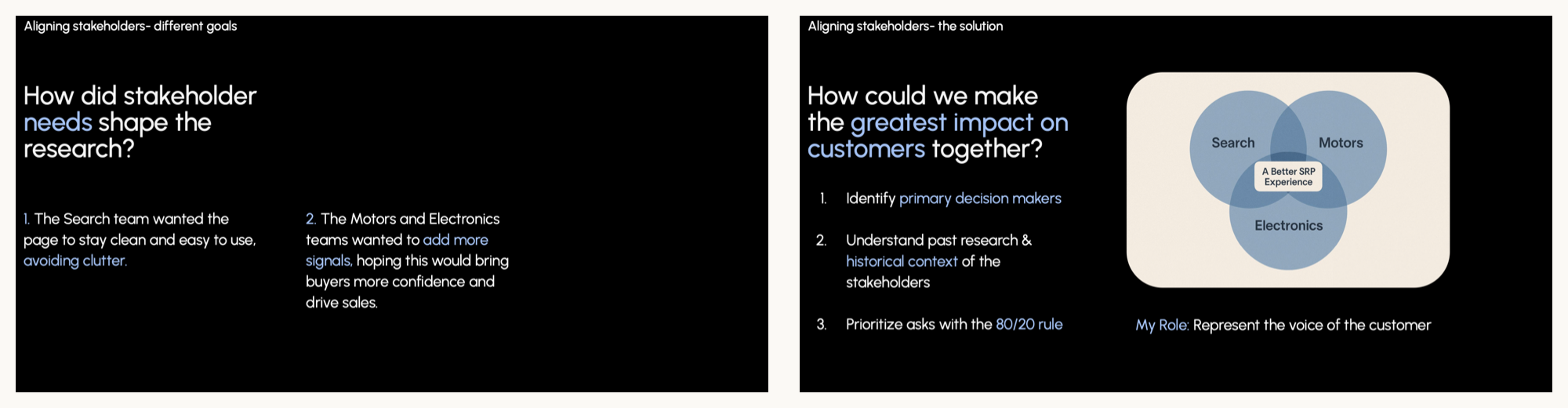
The stakeholder goals mattered because they created a decision.
The original explained what different stakeholders wanted. But there was a more interesting question underneath those goals:
How much information could the search results page show before it became harder to use?
More information could help buyers feel confident about a purchase. It could also make the page harder to scan.
That gave the reader a reason to care about the stakeholder section. They could understand the tradeoff and why research was needed to help work through it.
The rewrite brought that decision forward:
Keep the page easy to scan. Give buyers enough information to feel confident.
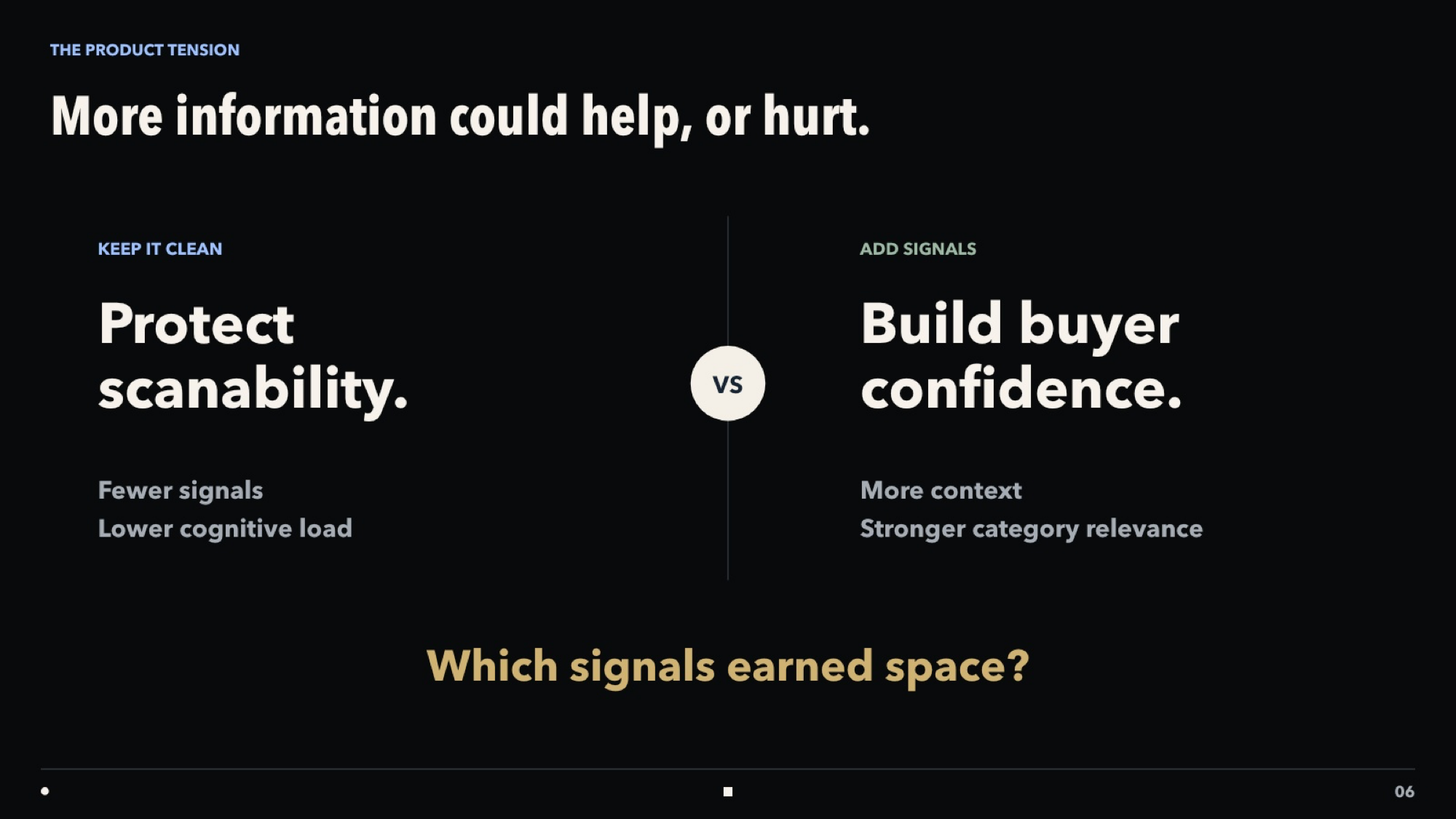
Those competing priorities were already in the project. I made the connection more explicit so the reader could see what was at stake.
I wanted the reader to understand what Amandeep contributed.
Amandeep sometimes described the work as “we did this as a team.” That makes sense for a collaborative project, but it can leave a hiring manager unsure about what you actually did.
The challenge is being specific without taking credit for other people’s work.
I separated his contribution into the research evidence he shared, the work he did with cross-functional partners, and the prioritization and delivery that belonged to the product teams.
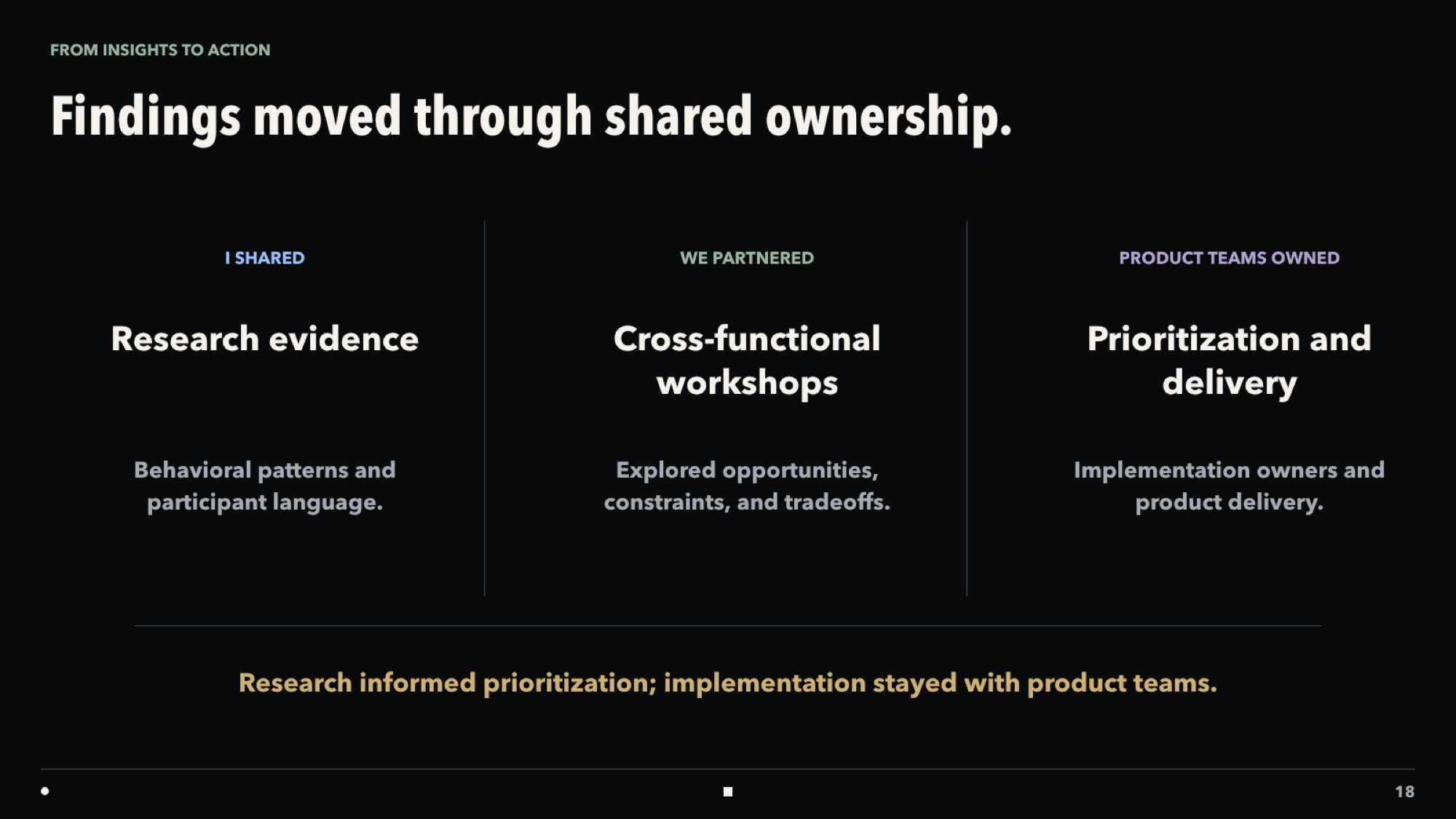
That made his role easier to understand while still giving the team credit.
It also helped Amandeep see his own work differently. He talked about recognizing the leadership he had demonstrated as an individual contributor:
“It was empowering to realize the work you do, and that you can describe it in understandable terms.”
That’s a meaningful part of this for me. Sometimes you’ve been so close to the work that you don’t recognize what it says about you until someone helps you put it into words.
Each slide needed a point the reader could follow.
One of the first things Amandeep noticed was that the rewrite was easier to skim. There was less competing for his attention and, as he described it, “one message kind of per slide.”
The research methods are a good example.
The original already described the survey as the “what” and the interviews as the “why.” That connection was there, but I wanted it to be the first thing someone understood.
4,141 survey responses showed what mattered.
20 interviews helped explain why.
Now the numbers had a clear purpose. The reader could understand how the two phases worked together before getting into the details.
That was the thinking throughout the deck: what should someone understand from this slide, even if they only give it a quick look?
The results needed careful wording.
The project included measurable outcomes:
A 1.8% increase in click-through rate.
More than 250,000 Electronics listings using granular condition labels.
A 0.7% increase in add-to-cart actions.
Those numbers were in both versions. The important part was how we explained their relationship to the research.
The original described the decisions as “driven by research.” I made that language more careful. Related product changes showed measurable gains, with research contributing alongside other inputs.
I think that distinction matters. A reader should be able to see that your work contributed to something meaningful and understand how far that claim goes.
The results were worth including. They didn’t need a bigger claim with it.

What Amandeep noticed
“You didn’t really change what I was presenting. You changed how it was presented.”
He described the rewrite as “simple, more streamlined” and said he could skim it much faster while still understanding it.
His first written reaction was:
“The narrative flows very well now and I can see how a non researcher can quickly understand the methodology, insights and recommendations.”
That was the goal. Someone who wasn’t there, and who might not be a researcher, could follow the work and understand why it mattered.
What this project shows
A lot of the work happened before I rewrote the sentences.
I had to figure out where the reader needed context, which details deserved their attention, and how to explain Amandeep’s contribution accurately. Once those decisions were clearer, it became easier to see what to keep and what to cut.
Amandeep already had a project worth talking about. The rewrite helped him explain it to someone who didn’t know it as well as he did.
Explore another rewrite
See how organizational change became easier to understand
See the thinking behind the final screens
Does your portfolio show how good your work actually is?
UX Portfolio Rewrite
If you know the work is good but struggle to explain it, I can help you figure out what matters to the reader and write a case study that gets it across.